


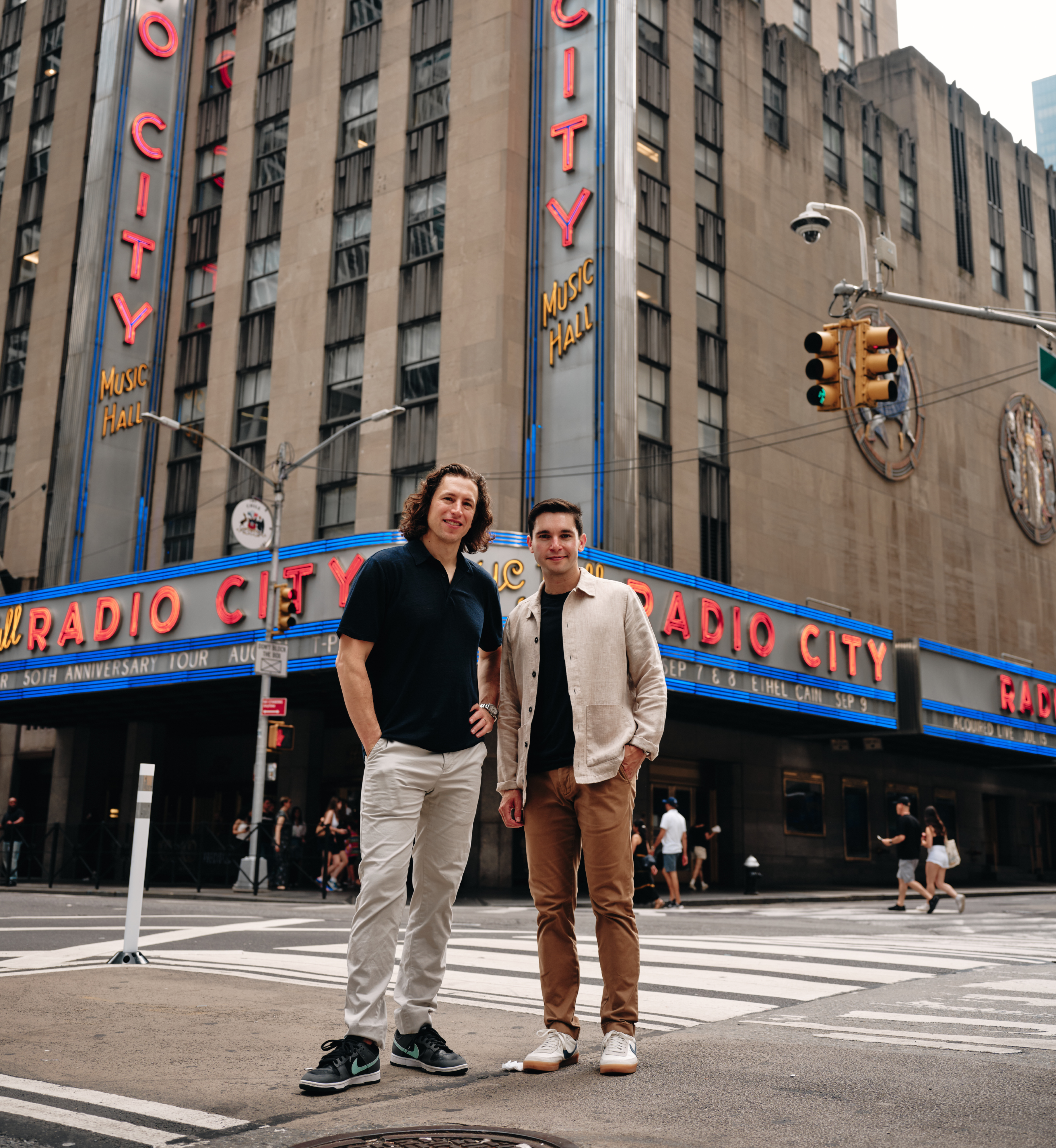
Hosts of the Tech Podcast 'Acquired' Talk Startups, Taylor Swift, and Selling Out Their First Radio City Show


Labor Day in NYC: How to Make the Most of Your Labor Day Weekend
5 Places at Rockefeller Center Where You Can Cool Off This Summer
Artist Greg Ito’s Multidisciplinary Work Encourages Moments of Meditation
A Look Back at the First 25 Years of Art Production Fund at Rockefeller Center
The Best Things to Do in NYC in July 2026
On their hit podcast, Acquired, Ben Gilbert and David Rosenthal dig into the histories and strategies of ubiquitous brands like Ikea, Nike, and Costco — but the friends have a success story of their own worth sharing.
The podcast they started for fun while working in the venture capital world now reaches more than 1 million listeners per episode, putting it at the top of technology podcast rankings on Spotify and Apple. This month, they added headlining a sold-out show at Radio City Music Hall to their list of accomplishments (along with snagging their own billboard in Times Square).
“We started the podcast as two guys with no revenue, no company, no distribution—it was 100% hobby and word of mouth,” Gilbert tells The Center Magazine. “To be here now is unbelievable.”

Taking the stage at Rockefeller Center was a full-circle moment for Gilbert and Rosenthal; their memories of this iconic stretch of New York City date back to school field trips, early career moments, and finding solace during the 2009 financial crisis. It’s also the setting for one of their most intriguing podcast episodes.
“Truly, there’s nowhere else in the world we’d rather do this,” Gilbert says. “From VIP events to fan meetups, from Rink hangouts to behind-the-scenes tours, lunch at Top of the Rock, photo shoots, and film days, the team at Rockefeller Center rolled out the red carpet in every way.”
We caught up with the podcasting pair on everything from this major Acquired milestone to Taylor Swift and their go-to Starbucks orders.

Q: Tabs open right now on your computer — how many?
Ben: Less than usual because I’ve been instantly archiving anything that doesn’t have to do with our Radio City show. Normally, I’m doing a whole bunch of background research, but right now it’s just the eight Google Docs we’re using to prep for the show, plus the five Google Sheets tracking all our event attendance. So… 13.
Q: Coffee order that says way too much about you?
Ben: Starbucks iced almond milk latte with whipped cream and a spinach feta wrap.
David: Ben has eaten more spinach feta wraps than any human in history. In the thousands, for sure. It was a whole thing in our Starbucks episode.
Ben: Between 2011, which is the earliest I can find data on, and 2023, I've spent $15,700 at Starbucks.
Q: What’s special or inspiring to you about doing the show at Radio City?
David: Well, it’s one of the most iconic places on Earth, period. Certainly the most iconic theater in the world. It's so personally cool for me. After college, I started my career here in New York. Rockefeller Center was my subway stop…I literally walked by it every working day for three years. I thought it was so cool that I got to work in Rockefeller Center and never imagined we would be on stage.
Ben: New York City is the center of the universe. I feel a completely different energy when I'm here than when I'm anywhere else, so I love being in New York. And Radio City is the most iconic place we could possibly do a show in the world. There are bigger venues, there are newer venues, but there are no more iconic venues than Radio City.
Q: How does Rockefeller Center — this “city within a city” — connect to your story?
Ben: Well, for Acquired, one of our sort of iconic episodes is the Standard Oil story. Which is really the Rockefeller story.
David: Yeah, and we kind of touch at the end what happened to the Rockefeller legacy after the 1800s and early 1900s, and we're sort of sitting in the most physical embodiment of it, which is really cool.
Ben: I grew up in Ohio, and on a school trip to NYC, 80 percent of my memories are from around Rockefeller Center — The Rink, the Tree, the Plaza. Icon after icon.
David: A good friend texted me recently, “It’s so cool you’re playing Radio City. Do you remember that night in 2009?” It was during the financial crisis. We were working in investment banking — really late nights, tons of layoffs, and devastation. One night, some friends saw I was having a rough time and said, “Let’s go for a walk.” We walked over to The Rink. I remember sitting there and just crying. And now… we’re playing Radio City. It’s incredible.

Q: If your work persona had a theme song, what would it be?
David: There's not really a delineation between work and brand life for us. But we have a theme song, “Who Got the Truth?” by Mike Taylor.
Ben: When I'm working, a lot of the time I listen to “The Social Network” soundtrack by Trent Reznor and Atticus Ross. There's something about the music itself that is just very good for productivity. It makes me work harder at whatever I'm working on.
Q: What email response gives you the ick?
Ben: All email gives David the ick.
David: Yeah, I don't do email. I’m lucky Ben handles most of it. Thank you, Ben!
Q: What's your personal KPI for a good day?
Ben: Hard workout, family time, inbox zero.
David: I’m never at inbox zero. A great day is when something serendipitous happens.
Q: Who’s the most unexpected person you’d want on your podcast?
David: Well, it’d be unexpected to the outside world, but I think extremely expected to people who are fans of Taylor Swift. We did an episode on the business of Taylor Swift. The conclusion we came to is that she’s one of the greatest CEOs of our generation. Then, when people find out we did an episode about Taylor Swift, they’re like, “What?” We would love to do a follow-up interview with Taylor.
Ben: This is off the cuff: Steven Spielberg. Acquired has become a creative act of its own and, in some ways, a performance art. It’s caused me to become more intrigued studying the really great storytellers across different mediums — great in script, with the camera, great actors. I would love to do a deeper study of the creative process, and Steven’s just someone that I think has been remarkable, hit after hit after hit. Once you’re lucky, twice you’re good… 30 or 40 or 50 incredible movies? There’s something to your process that is amazing, and I would love to interview and study that.
Q: What do you most admire in a founder’s personality?
Ben: Resourcefulness. Pretty much every great company we’ve studied, the person had their back against the wall in some way and had to figure out an unconventional way to leverage a relationship or an opportunity or timing — or even just a willingness to reach out to someone and plead their case — and be really clever about marshalling resources you wouldn’t have guessed they had in order to build their thing.
David: Self-belief. I think all of the founders we’ve studied had a real bedrock belief in what they were doing. Especially in the early days — it’s like something none of the rest of the world believes in. Even Rolex: Hans Wilsdorf believed wristwatches could be real timekeeping pieces. That was heretical. Pocket watches were serious timekeeping tools. Same with Google. Larry and Sergey had a fundamental belief that this was the right way to organize the internet’s information. Almost nobody believed them.

Q: What would your co-host say is your most podcast-y habit?
David: Ben has always made what we do into a podcast — he does our intros, our closings, and just has a natural way of turning what we do into a show. It wouldn’t be what it is without that.
Ben: David is the reason Acquired is about stories. He shows up every time with a 75-page Google Doc, written in bullet point form, with the entire narrative arc of the story. I bring almost no story. He writes the damn story.
Q: What’s a business story happening right now that you wish more people paid attention to?
Ben: AI is completely changing the world. Everyone is talking about this, but I think it is still underestimated. Like other technology waves, like a computer or phone, it makes everyone more productive. AI is another increase in the leverage that technology provides humans. I do think that it is concerning in the short term — because you can do way more with fewer people — but in the long term, humanity can accomplish way more.
David: J.P. Morgan and how Jamie Dimon has turned it into more than a bank. It is a stabilizing financial force in the global economy. It has played out right here over the last 20 years. That’s thanks to Jamie Dimon. Other banks have taken short-term, greedy views. Jamie’s taken a stable, long-term view — the “fortress balance sheet” strategy. It’s likely saved the global financial system more than once.





10 Secrets You Didn’t Know About Radio City Music Hall


The Rockefeller Center Guide on Where to Eat Before or After a Broadway Show
A Broadway Star Raised at the Rainbow Room: Counting Down to the Tony Awards With Klay and Kara Young

The Story Behind Pebble Bar and Its Legendary New York City Address
The Center Newsletter
Receive important seasonal news and updates, learn about store openings, and get special offers.